The Long Road to Nihongo
Part 1
A fake-it-till-you-make-it approach to language learning
April 2026. I’m in Tokyo with Folding Bike Tour of Japan #5. Day two of the tour. Our local guide is my friend Aisaku Oruto, architect and novelist. Carl is sitting on the other side of the table at lunch. I am interpreting his questions and Oruto-san’s answers. At one point, Carl turns to me and says: “I want you to translate this exactly: Ask him, ‘How good is Alex’s Japanese?’” Oruto-san does not hesitate, uttering a single word: “Kanpeki.” I blush but render the word faithfully: “Perfect.”
* * * * *
Summer 1978, Middlebury, Vermont. Middlebury College’s Summer Language Institute, the intensive nine-week course in elementary Japanese. A different word was uppermost in my mind: Hopeless. That I had no hope of ever mastering this language.
I am 19 years old and have come up from New Jersey to Middlebury, my first extended stint away from home. 48 years later, I recall the names of most of my instructors. Seiichi Makino of the University of Illinois directs the summer program (at the time, Middlebury did not offer Japanese classes during the regular academic year). The first-year program is led by Tazuko Monane of the University of Hawaii. She is assisted by Kinoshita-sensei (University of Illinois), Yamamoto-sensei (University of Chicago), and several others whose names I do not recall.
At the first evening’s gathering for beginning students, Makino-sensei teaches us this phrase: ____ wa Nihongo de nan to iimasuka (__は日本語でなんと言いますか。) “How do you say _____ in Japanese?” The students repeat the expression several times. It does not stick with me. Middlebury’s Summer Language Institute is famous for its immersive language learning model and for the “Language Pledge®” in which students promise to use the language they are learning as their sole means of communication while at the school.
In 1978, the Japanese School has been in existence for a scant six years. We all know about the pledge, but there was clearly little expectation on the part of the faculty that the beginner students would be able to communicate in even rudimentary Japanese. We could not even say O-tearai wa doko desu ka (お手洗いはどこですか): “Where is the bathroom?” In fact, most classroom instruction, including long explanations about Japanese grammar and syntax, is conducted in English, not Japanese. Years later, I realized that this approach simply reflected the kind of school instruction of English in Japanese schools, where English was taught not so much as a living language, but more like a dead language like Latin or Greek
By completing the 10-credit Japanese course, I would fulfill the requirements for my BA degree from Rutgers College (the State University of New Jersey). I’d been accepted into the graduate program in history at Columbia University (without financial assistance). My plan was to study Japanese history. But in the summer of 1978, I am a mere 19 years old, turning 20 that October. I am not a genius, and I am certainly not prepared for graduate study.
I finish the first-year Japanese course at Middlebury that August. I studied all night before the final exam (my one and only “all-nighter”). As the sun rises over the bucolic campus, I have an epiphany: I must defer starting at Columbia by at least a year. I know I am not ready. A great burden is lifted off my shoulders, and I literally feel lighter. I turn in a passable performance on the final exam and earn a respectable “B”. But I know that the grade is meaningless because I truly have no idea of how the Japanese language works. (I can, however, inquire where the bathroom is.)
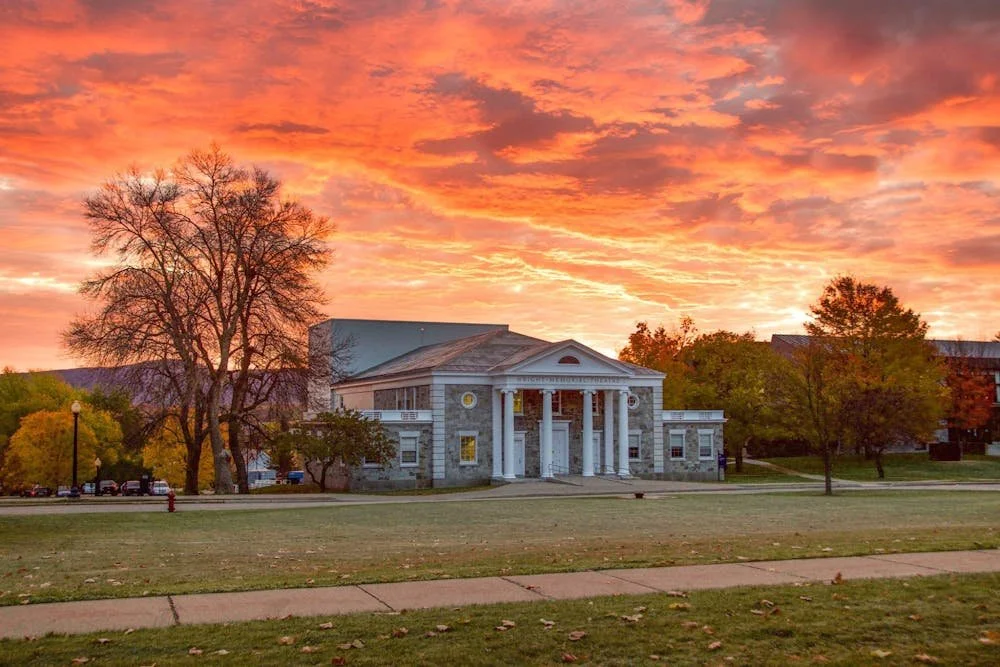
Middlebury College
When my parents pick me up, I tell them of my decision not to go to Columbia in September. They listen to me, but my father is clearly disappointed. He tells me later that if I do not accept Columbia’s offer of a seat in the grad program, I run the risk of “losing momentum,” whatever that is. Even at not-yet-20, I suspect that I should stand firm by my decision. My father had pushed me willy-nilly through school all along: a too-early start in primary school, a grade skipped, a rush to finish a college degree in three instead of four years. Whatever my (dubious) intellectual development, my social development is lagging far behind that of my classmates at every level. Dad says: “Don’t go full time to Columbia. Take a half-load and see how it goes.” And so I do.
At Columbia, I take a history course taught by H. Paul Varley, a scholar of Medieval Japanese history. I am out of my depth: On the blackboard, Varley writes kanji characters identifying wars and important historical figures. These the students would dutifully copy down in their notes. I have no idea how to write these characters and can barely keep up with the class.
I decide – correctly, as it happens – that I need to repeat elementary Japanese. I take Ichiro Shirato’s intensive course, which is designed to cram a full year of basic Japanese into a single semester. That and Varley’s history course constitutes my entire program of study at Columbia. Shirato-sensei has been teaching at Columbia since before World War II. He taught Japanese to some of the linguists who helped U.S. forces decode Japanese signals and figure out what enemy forces were planning. Some of these men (in those days, Columbia was men only) played important roles in the postwar occupation of Japan. I was honored to be in Shirato-sensei’s class, but once again, my Japanese teacher spends far too much class time explaining grammar patterns in English. He digresses, frequently, to share interesting anecdotes from his past, including the time he attended a large inter-tribal powwow out West where he was repeatedly assumed to be Native American. I remember the stories from his class, but not much Japanese.
安らかに眠ってください、白土先生。(Yasuraka ni nemutte kudasai, Shirato-sensei; Rest in peace, Shirato-sensei)
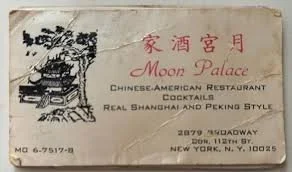
Card from the Moon Palace
restaurant on Upper Broadway
One of Shirato-sensei’s favorite haunts
I do respectably enough in my first – and only – semester at Columbia University, but I do not see a future for myself there. And I certainly do not want to run up additional debt to pay for schooling leading to an uncertain future.
In 1980, I am accepted into the MA program at the University of Chicago’s Committee on International Relations. This time I have a fellowship to cover tuition (but not living costs). Maybe I’ll become a diplomat. I later decide to go into Naval intelligence. During my first quarter at Chicago, I take second year Japanese with Yamamoto-sensei, who had been a member of the faculty at Middlebury. He is a small man who projects an air of toughness, something of a Yukio Mishima vibe. Again, he spends a lot of class time speaking in English, including colorful stories about bow hunting in the Wisconsin woods. Some weeks into his class, he tells me that I am not doing very well and that he will have to give me a “C”. I am deeply disheartened. I take my “C” and, once again, decide that Japanese is hopeless.
I go through the MA program in three quarters, pass the qualifying exam, and somehow manage to pass a reading test in French (I negotiate with the graduate student scoring the test to eke out a passing score). To get the MA, I just need to complete a short thesis. I’ve chosen what turns out many years later to be an excellent topic: the ownership of oil resources in the East China Sea. Despite several tries, I never do complete that thesis.
In the summer of 1981, I do an internship in the Department of State’s Bureau of Intelligence and Research. I have a date to start in the U.S. Navy’s Officer Candidate School in Pensacola, Florida in early 1982. In Washington, however, I fall in love with a girl of mixed Japanese and Jewish parentage. By the fall of 1981, I decide to back out of the Navy (much to the consternation of the recruiter at the Great Lakes Naval Air Station north of Chicago). I am not going into the Navy, but I am still very much at sea: The thesis is not writing itself; I’ve moved back into my parents’ house; I have no idea what I’m going to do.
I decide that the best thing for me is to go to Japan.
It is the Golden Age of the Eikaiwa no sensei (英会話の先生), the English conversation teacher. Easy work, good pay, easy living. With the help of the Princeton in Asia program (through my Rutgers professor, I develop a connection at Princeton), I find a job as a teaching assistant at the Institute for International Study and Training (貿易研修センター) on the slopes of Mt. Fuji in Shizuoka Prefecture. In the spring of 1982, I am living in an English-speaking dormitory at IIST helping Japanese businessmen and engineers prepare for their first overseas assignments.
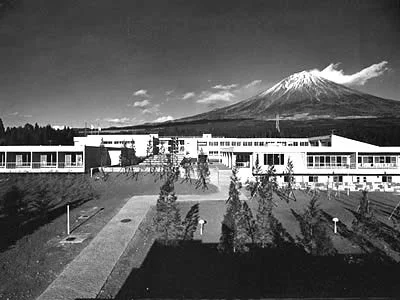
Institute for International Study & Training
I spend the first week or two wondering where on earth Mt. Fuji is. One morning, I step out of the dormitory, look up, and there it is: the clouds have cleared and the mountain takes up half the sky. It is one of the most glorious sights I have ever seen.
(To be continued)