The Long Road to Nihongo
It is the fall of 1978. A graduate student at Columbia, Cheryl, tells me it takes two years to master spoken Japanese…and at least 10 years of serious study to master the written language. I’ve been at it since 1978 – 48 years and counting – and I’m not there yet.
But Where is “there”?
I’m currently reading a novel by Haruki Murakami at the moment (国境の南、太陽の西; Kokkyō no minami, taiyō no nishi, South of the Border, West of the Sun). I find Murakami’s Japanese very readable, as if it had been written so it could be read by a gaijin like me, or with a view to having it translated into English (others have noted that Murakami’s prose is “Englishy”)[1]. Yet even here I constantly run into words unknown to me, like this one: 変貌. Something to do with change, and I know I’ve seen it before. No doubt that the first character is pronounced hen (“change”), but I simply cannot remember how to pronounce the second character. I struggle with my new phone, trying out the stylus. Success! The compound of the two characters (熟語; jukugo) is pronounced henbō and it means “transformation,” or even “transfiguration.” (Not sure of any spiritual or religious connotation here). I’ve already needed to look up at least a dozen words in the first 30 pages of the novel.
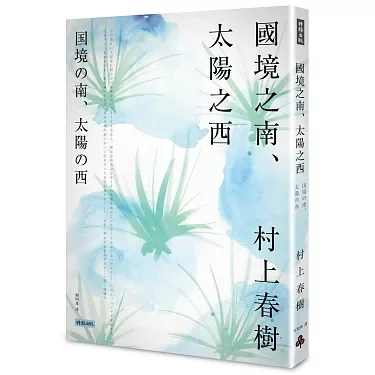
Haruki Murakami’s South of the Border, West of the Sun
Part of the problem is that I have not read a lot of Japanese literature in the original language. For years, I have worked as a translator, calling myself a “commercial translator.” In practice, this means that I have translated almost everything except literature: Technical documentation, patents, legal contracts, website content, business correspondence, family register entries (records of births, marriages, divorces, deaths). People ask me: Do you translate novels? Poetry? No, I do not. There’s no money in it. It’s the sort of thing done by people with academic affiliations or simply as a labor of love. I don’t know how much Jay Rubin, Murakami’s main translator into English, makes for translating a novel. As the translator of Japan’s most widely-read author, Rubin must do quite well. (By the way, a rumor has gone around for years that Murakami writes his novels first in English, and then translates them into Japanese, in the manner of the way Irish-born writer Samuel Beckett wrote classics like Waiting for Godot and Endgame in French and then translated them into English, his native language. Rubin debunks this myth in a talk he gave in 2018 at the University of Michigan {at about 51minutes into the video.})
For years until AI came along and effectively killed the translation business, I did not feel inclined to crack open a novel after spending the day translating a patent or contract. To this day, I feel a bit like a fake: I claim to love the Japanese language, but I have generally avoided training myself to read the language in its most evocative form, literature. Without a doubt, one of the best ways to engage with a culture is through its poetry and prose. I question the degree of my commitment. I feel impostor syndrome.
* * * * * *
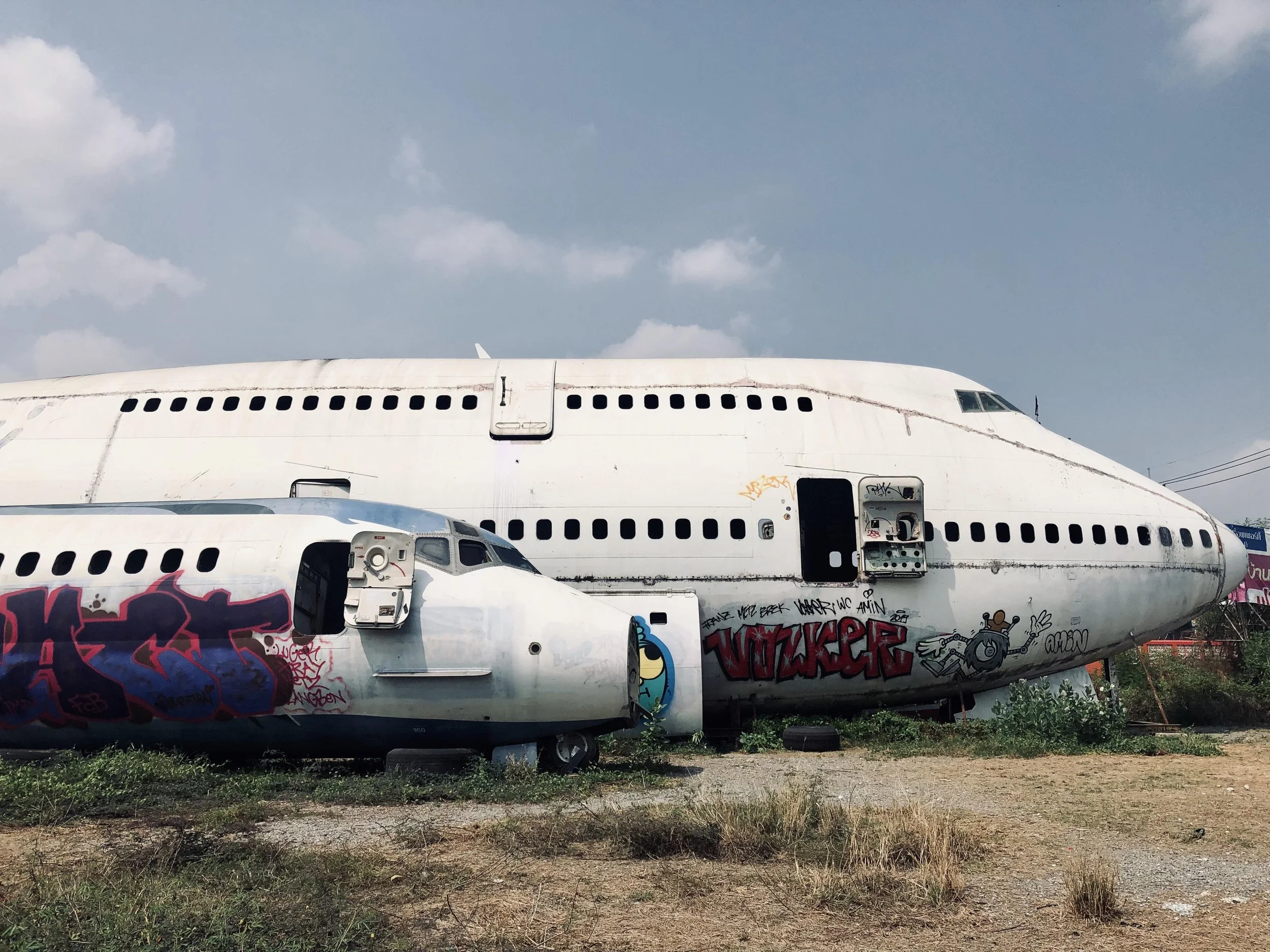
747 at the end of the road
May 1982. I’m sitting in the forward-most seat of what even 44 years ago was an ancient 747. Going through the miniscule classified ads in an obscure corner of the New York Times, I have found the cheapest possible roundtrip ticket between the East Coast and Japan: about $850, nearly $3,000 in 2026 dollars. The route this long-defunct airline takes is truly a hero’s journey: Newark Airport (New Jersey) Oakland, CA (change planes, with interminable delay due to “mechanical issues” with the dilapidated 747 which necessitate sleeping on the floor of the departure lounge) Seattle Anchorage Taipei, Taiwan (change planes again) Hong Kong (overnight stay in a hot, squalid fleabag hotel where the water is turned off at night) back to Taipei finally to Narita Airport outside of Tokyo. Not a hero’s journey: an ordeal. I learn later that this airline had contracted with the U.S. government to ferry Vietnamese refugees (“boat people”) from Manilla and Bangkok to the U.S. The airline sold discount tickets to fools like me so they would not be stuck flying an empty plane between the U.S. and Asia.)
I arrive at Tokyo Station. The trip has taken so long that I have missed my ride to the Institute for International Study and Training (IIST) in Shizuoka Prefecture on the slopes of Mt. Fuji. Somehow, I contact the school by telephone. I am told to take a bus from Tokyo Station to an interchange off the Tōmei Expressway. From there, I am to take a taxi to IIST.
The school is a beautiful place. Apparently designed in one go in the 1960s in the cast concrete style of Le Corbusier. The campus is redolent of the pine forest surrounding it. I have reached Shangri La.

Institute for International Study and Training, Fujinomiya, Shizuoka
I settle into my dormitory room. There are about 10 Japanese men who have arrived before me. The men are to be wholly immersed in the English language in preparation for their first overseas assignments. My job is to enforce an “English only” rule. By the time I get there, the men are in the middle of a rollicking drinking party. One man sidles up to me – I later learn he is a banker from Shizuoka. Slurring his words, he asks me emphatically, “Do you like to faaaku?!” So much for Japanese subtlety and politesse. I say, “Well, yes, I do.” The banker seems pleased. In a later exchange, he demonstrates how, though half my size, he can neatly pick me up by my belt and toss me to the ground; turns out he is an nth degree black belt in some kind of martial art.
IIST is a lovely place. The accommodations are comfortable, the food is good, and the workload is light. There are attractive young Japanese women working in the library. Neither I nor any of my fellow teaching assistants (all of whom are American) has even a ghost of a chance with them. We do, however, have access to a 50cc motor scooter; it’s fun to ride up and down the mountain roads or to venture into the nearest small city, Fujinomiya. On the main shopping street there are plastic flowers and piped-in background music enlivening the drowsy shopping arcades.
I find myself pining for my girlfriend back home. Karen and I exchange a couple of letters. I feel homesick and, after about two months, decide I want to go home. I inform my parents on a very expensive international phone call from the payphone in front of the library. My mother is not impressed: she says it would be a waste for me to have gone all the way to Japan only to come scurrying back to my girlfriend. My mother suspects – correctly, as it turns out – that Karen and I do not have a future together. Mom persuades me to stay in Japan. It was the right choice. Thank you, Mom!
I know I must get off this lovely but isolated mountainside. My job at IIST is to be an “English informant,” a human version of a language lab tape recorder. I realize that I am unlikely to learn Japanese at this place. I can see that most of the full-time teachers do not speak Japanese very well. At IIST, I do not have to shop for my food or do any of the sorts of daily life activities that would connect me to the language and culture. I’ve got to find work elsewhere.
One of the teachers tells me about an English teaching company with hole-in-the-wall offices in Osaka. After completing about three months of service at IIST, I take a job with Nippon Information and Communication (NIC) which sends me to Western Japan, to the small city of Kurashiki in Okayama Prefecture. My main job is to teach spoken English to employees of the Kawasaki Steel Corporation’s Mizushima Works on the Inland Sea.

Kawasaki Steel, Mizushima Works
It is in Kurashiki and Mizushima that I begin to learn Japanese in earnest. I fill notebooks (some of which I still have) with new vocabulary, I practice writing kanji, I try to speak Japanese whenever I can. But the language remains elusive and I struggle to understand what people are saying. I resolve, however, not to be the kind of long-term expat who never masters Japanese, who gets by on a few broken, poorly-pronounced phrases, content to be flattered into believing it when people say あっ!日本語、お上手ですね!(Ah–! Nihongo, o-jōzu desu ne!; “Wow! You speak Japanese so well!”). That compliment soon becomes the bane of my existence. Hearing it repeatedly in response to the most basic Japanese expression, as in:
Hajimemashite. Arekkusu desu. Dōzo yoroshiku onegai shimasu. (“How do you do. My name is Alex. Nice to meet you.”
Ah! Nihongo, o-jōzu desu ne!
I begin reinterpreting the ostensible compliment as: “Very clever of you to say something in our language. Now stop that nonsense and be a proper gaijin!” Over the years, I come to realize that a Japanese person’s response to a Japanese-speaking gaijin like me is complex and far more nuanced than that. And now that I actually speak, read, and write Japanese with reasonable facility, I am more likely to take the compliment with a humble arigatō gozaimasu.
[1] “Murakami's prose is minimalist, straightforward, and clear, yet it has a lyrical quality conveying deep emotion and philosophical insight. He avoids overly ornate language, opting for simplicity and precision in his descriptions and dialogue. This approach allows readers to focus on his stories' symbolic elements without being overwhelmed by the language itself.” -Matthew Long, Beyond the Bookshelf, September 10, 2024 (https://matthewmlong.substack.com/p/murakamis-maze)